If you’ve spent any time in community-led recovery or harm reduction spaces, you already know the unwritten rule: the people doing the heaviest heavy lifting are almost always the ones with lived experience.
We become peer supporters, outreach workers, group facilitators, and late-night emergency contacts because we know what it feels like to be written off by traditional systems. Our empathy is our super-power.
It is also our greatest vulnerability.
When your work, your community, and your personal survival identity all overlap, the line between caring and collapsing gets paper-thin. Burnout in underground and alternative recovery isn’t just about being tired—it’s a systemic risk to our movement. If we run ourselves into the ground trying to hold up the sky for everyone else, there’s no one left to keep the lights on.
Here is a guide to building sustainable emotional boundaries, protecting your capacity, and practicing radical self-preservation while doing deep community work.
1. Recognize the “Hero Complex” Trap
Many of us enter peer support with an unconscious sense of urgency born from trauma. We’ve lost friends, survived overdoses, or navigated brutal institutional harm, so saying “no” to someone in crisis feels like a betrayal.
- Separating empathy from rescue: Empathy means standing alongside someone in their pain; rescuing means believing it’s your job to solve it for them. You can be a solid, loving presence without carrying the outcome of someone else’s life.
- Audit your motives: Ask yourself: Am I taking this extra shift or answering this 2:00 AM call because I have the actual capacity, or because I feel guilty? Guilt-driven care always leads to resentment and exhaustion.
2. Map Your Capacity in Real-Time
Burnout doesn’t happen overnight—it creeps in through small, daily compromises of your own boundaries. To stay in this work long-term, you need an honest diagnostic system for your mental and physical energy.
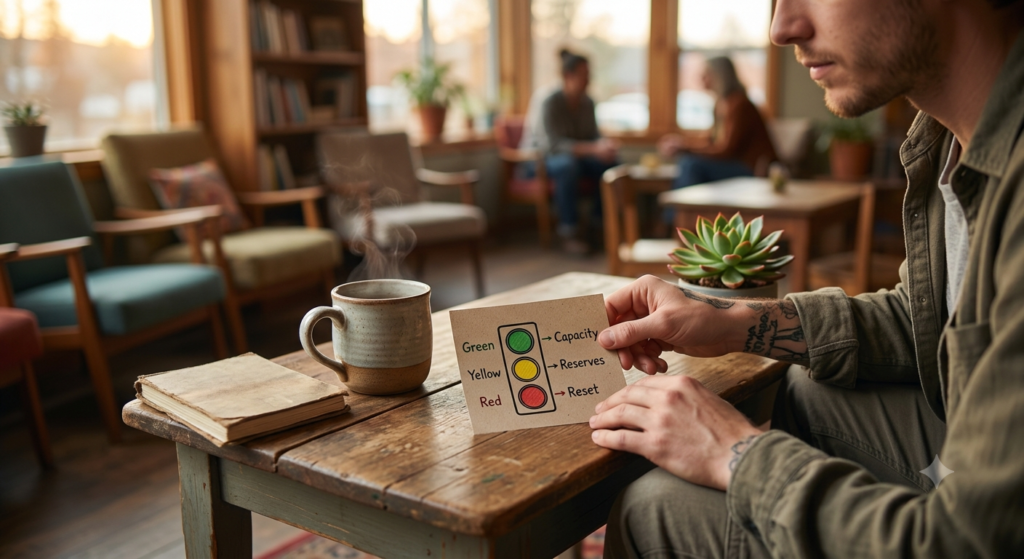
Consider using a simple Traffic Light System for your daily capacity:
- Green Light (Full Battery): You have surplus energy. Great day for direct outreach, facilitating groups, or doing high-intensity crisis work.
- Yellow Light (Low Battery): You’re functional but running on reserves. Time to stick strictly to scheduled hours, delegate tasks, and step back from high-acuity situations.
- Red Light (Depleted): You are operating on fumes or actively triggered. Step completely off the front lines. Taking time to recharge isn’t selfish—it’s an ethical requirement of peer support.
3. Establish Tactical Boundaries (That You Actually Keep)
In grassroots and non-traditional recovery spaces, boundaries often feel clinical or cold. But clear limits aren’t walls to keep people out—they are guardrails that allow you to stay accessible without falling off the edge.
- Set hard digital cutoffs: Create a separate phone number (like Google Voice) for community work. When your shift or designated availability ends, turn those notifications off.
- Normalize the “Warm Hand-off”: You don’t have to be the single point of contact for every person you support. Build a network of trusted peers so you can say: “I’m stepping offline for the evening, but here are two other people/resources ready to listen.”
- Decline without defending: Practice saying, “I don’t have the emotional bandwidth to give this the attention it deserves right now, so I need to step back.” You don’t owe anyone a detailed medical or personal justification for resting.
4. Shift from Self-Care to “Community Care”
Individual self-care (bubble baths, turning off your phone) is essential, but it won’t fix structural exhaustion. True sustainability happens when recovery spaces build a culture where collective care is built into the framework.
- Build debriefing rituals: After heavy calls, naloxone reversals, or intense group sessions, don’t just move on to the next task. Spend 10 minutes checking in with another peer worker to process the emotional weight.
- Normalize time off: If you run a group or mutual aid meeting, cross-train co-facilitators so anyone can take a week—or a month—off without the group collapsing.
- Celebrate non-recovery life: Make sure your life includes spaces, hobbies, and relationships that have absolutely nothing to do with substances, harm reduction, or processing trauma.
The Bottom Line
You cannot pour from a dry well, and you cannot save anyone by drowning next to them.
Our communities don’t just need passionate advocates today—they need advocates who will still be healthy, grounded, and alive five years from now. Reclaiming your right to rest, set limits, and walk away when your tank is empty isn’t a failure of solidarity. It’s how we make sure the underground stays alive.